BJJ gym metrics: what an owner should check every week
The numbers a BJJ academy owner should check every week: what each one means, which time window to read it over, and what to do when it moves.
Most academy owners look at their numbers in one of two ways. Either they never look, and find out the gym is shrinking when the bank balance tells them. Or they look at everything, every day, and react to noise: a quiet Tuesday, a bad week of rain, one cancellation that feels like a trend.
A weekly review sits between the two. Same day, same handful of numbers, about twenty minutes. Long enough to spot a real change, short enough that one odd day doesn't send you into a panic.
This guide covers what to check, how each number is defined, which time window to read it over, and what to actually do when it moves. Most of the numbers are simple. The traps are in the definitions: what counts as "active", what the percentage is a percentage of, and which money figure you are looking at.
Three rules before the numbers
Same day, same time. Monday morning works for most owners: the week is fresh and the weekend's open mat is counted. Whatever you choose, keep it fixed, so every review compares like with like.
Compare with yourself, not with an industry average. Published benchmarks for small BJJ academies are thin, and most of the numbers you see quoted come from big-box gyms or from nobody in particular. Your own last eight weeks are a better reference than anyone's average.
Every number needs a response. If a number moving wouldn't change what you do this week, drop it from the weekly review. Check it monthly instead, or not at all.
1. Active members: a count of paying memberships
What it is. The number of memberships that are paid up and billing today.
The definition matters. Decide what you count and stick to it. Most owners land on "memberships currently paying". That means:
- Not counted: free trials, paused memberships and anyone whose payment is failing. Count those separately, because they need different responses.
- One family bill counts once if you count memberships. If you would rather count people on the mats, that's fine too. Just don't switch between the two, or your trend line will jump for no reason.
Window. A point-in-time count. The useful weekly number is the change: how many started this week, and how many ended.
What to do. A flat count can hide a lot of movement. Five new members and five leavers is a very different week from no change at all. If leavers outnumber starts for three or four weeks running, that is a trend worth acting on: look at the members going quiet (below) before you look at marketing.
2. Recurring revenue, cash collected and payouts are three different numbers
This is the one most owners mix up, so it is worth getting straight once.
Monthly recurring revenue (MRR) is what your active memberships would bill in a normal month. Weekly and fortnightly plans are converted to a monthly figure: a $45 weekly membership is $45 × 52 ÷ 12, which is $195 a month, not $180. It is a run rate, not money in the bank.
Cash collected is the money that actually came in over a period, after refunds. It differs from MRR because some payments fail, some members are paused, billing dates fall unevenly through the month, and one-off sales like class packs, seminars and merchandise land here too.
Payouts are what your payment provider sends to your bank account. They come after processing fees and on a delay, so this week's payout is mostly last week's payments.
| Number | Answers | Check it |
|---|---|---|
| MRR | Is the membership base growing or shrinking? | Weekly, as a change |
| Cash collected | Did the money actually arrive? | Monthly, and for your BAS |
| Payouts | What will reach the bank and when? | When you plan cash flow |
Window. For a weekly review, read MRR as a change since last week. Cash collected is more useful month to date, because billing dates make individual weeks lumpy.
What to do. If MRR is flat but cash collected is falling short of it, the gap is usually failed payments or pauses. That's the next number. If MRR itself is falling, the cause is fewer memberships or cheaper ones. Check whether people are moving down to cheaper plans, not just leaving. For the tax side of cash collected, see the GST and BAS guide.
3. Failed payments: count the members, then the money
What it is. Memberships with a payment that hasn't gone through. Two numbers are worth separating:
- Currently failing: how many memberships are overdue right now, and what they are worth per month.
- Newly failed: how many started failing in the last seven days.
A retried payment that fails three times is one problem, not three. Count members or invoices, not attempts, or your number will look worse than it is.
Window. Currently failing is a snapshot. Newly failed is the last seven days.
What to do. Look at the newly failed list first. Those are the members you can still recover quietly, with a neutral notice and a link to update their card. Anyone who has been failing for a few weeks needs a personal call, not another reminder. The failed payments guide covers retry timing and the message sequence in detail.
4. Attendance: a seven-day total, read against the trend
What it is. Total check-ins over the last seven days, compared with the seven days before.
Window. Use rolling seven-day windows rather than "this week so far", so a Monday review isn't comparing one day with seven.
How to read it. Attendance is the noisiest number on the list. Public holidays, school holidays, a tournament weekend, a run of rain or one coach away will all move it, and none of those mean the gym is in trouble. So:
- Look at four weeks, not one. One down week is weather. Four down weeks in a row is a trend.
- Note the reason. Write "Easter" or "comp weekend" next to an odd week, so you don't puzzle over it in a month's time.
- Look at frequency, not just totals. If you can, check how many members train once a week, twice, three times. A shift from twice a week to once a week across the roster shows up long before anyone cancels.
What to do. A sustained drop is a question for the mats, not the spreadsheet. Has a popular class moved? Is a coach away? Are beginners finding the classes too hard? Ask a few members before you change anything.
5. Members going quiet: a list of names, not a rate
What it is. The members who have stopped turning up, ranked by how long it has been since they last trained, plus any other warning signs: a failed payment, a cancellation request, or a broken training habit.
Window. Days since each member's last check-in. A fortnight away is usually worth a look. Longer than that, contact them.
Why it's a list. This is the one review item that should never be a percentage. "4% of members are inactive" tells you nothing you can act on. Five names tells you exactly who to call.
What to do. Pick the top five. Check your notes first: injury, travel, a conversation you have already had. Then call or send a personal message. The retention guide explains why new members are the ones to reach first, and what to say.
6. Trial conversion: know what the percentage is a percentage of
What it is. The share of trial leads who became paying members.
The denominator is the whole story. "Conversion" can mean at least three different things:
- Of everyone who enquired, how many joined.
- Of everyone who booked a trial, how many joined.
- Of everyone who actually attended, how many joined.
On the same week of trials these give very different numbers, and each answers a different question. Enquiry to member measures your whole funnel, including how fast you reply. Attended to member measures the class itself and the conversion conversation afterwards.
Here is a fictional example. Twenty people enquire in a month. Fourteen book a trial, ten turn up and six join.
| Measured from | Calculation | Conversion |
|---|---|---|
| Enquired | 6 ÷ 20 | 30% |
| Booked a trial | 6 ÷ 14 | 43% |
| Attended | 6 ÷ 10 | 60% |
All three are true. Pick one definition, write it down and stick to it.
Window. Use a rolling 90 days, not a week. With ten trials a month, one person changing their mind moves a weekly percentage by ten points or more. Weekly percentages on numbers that small are mostly noise.
What to check weekly instead. The leads nobody has contacted yet. That number should be zero every Monday, and it is the one you can fix today. The trial conversion guide covers what to do in the first seven days after a trial.
7. Retention and cancellations: monthly numbers, weekly list
Churn rate is the share of memberships that ended during a month, out of those active at the start of it. It is a monthly number, and a weekly review should treat it that way. Early in a month it will look tiny, because hardly anything has ended yet. Read it once the month is over.
Cohort retention groups members by the month they joined and shows how many were still training one, two and three months later. It answers the question churn can't: are this year's new members sticking better or worse than last year's? Review it monthly or quarterly.
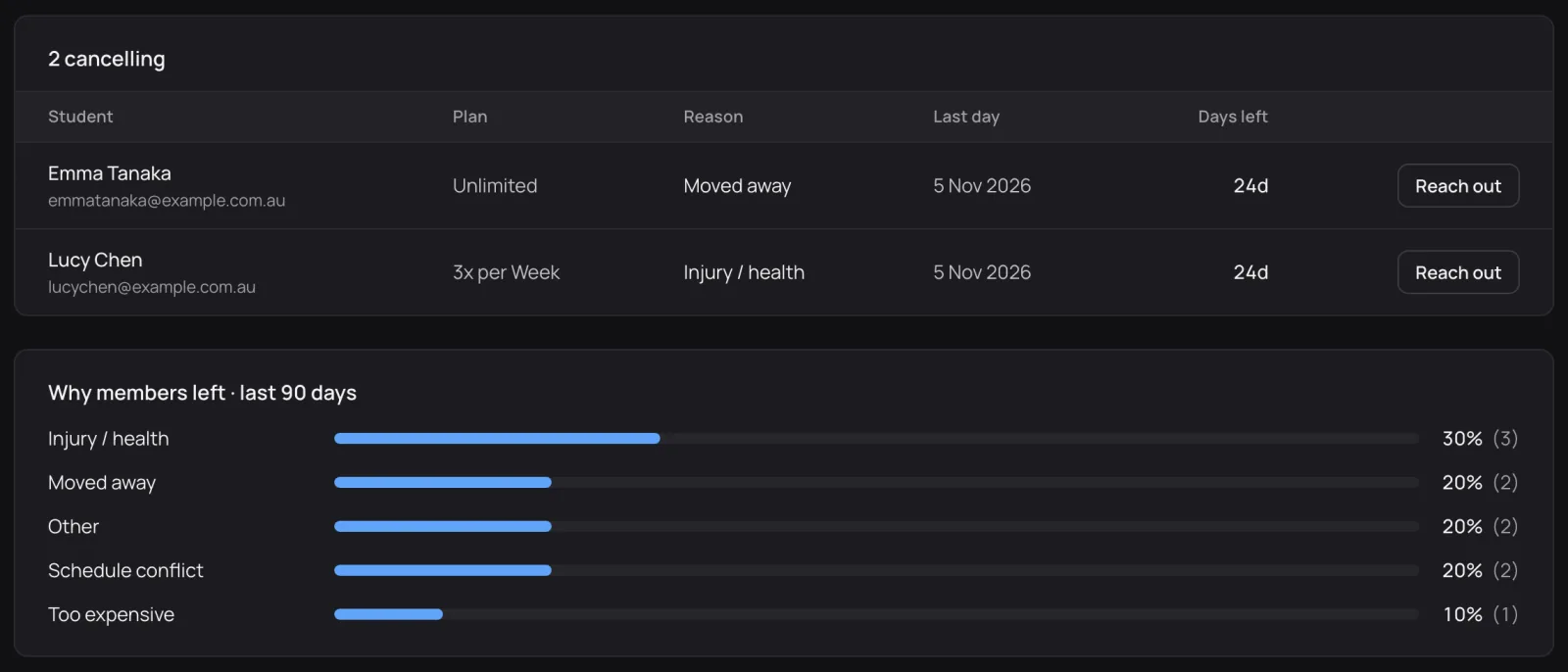
What belongs in the weekly review is the list of members who have asked to cancel and haven't left yet, with their reasons. A cancellation request with three weeks left on it is still a conversation you can have. Sometimes the answer is a pause, a different plan or a class at a time that suits them. Sometimes it is a genuine move interstate, and the right response is to thank them.
The twenty-minute weekly review
Use this as your Monday routine. Each line has a number, a window and the question it should prompt.
| Check | Window | The question | If it moved |
|---|---|---|---|
| Active memberships | Today, vs last week | Did more start than end? | Three weeks of net losses: review who's going quiet |
| MRR | Change since last week | Is the base growing? | Falling: check leavers and plan downgrades |
| Failed payments | Now, plus last 7 days | Who started failing this week? | Notice to new failures, call the long-running ones |
| Check-ins | Last 7 days vs previous 7 | Is the four-week trend down? | Ask members before changing the timetable |
| Members going quiet | Days since last check-in | Who are the top five? | Call or message them this week |
| Uncontacted leads | Now | Is it zero? | Contact them today |
| Cancelling soon | Now | Who can I still talk to? | Have the conversation before their last day |
And once a month, add the slower numbers: churn for the month just finished, cash collected against MRR, cohort retention and your 90-day trial conversion.
Write down one action per number that moved. A review that ends with three names to call and one lead to chase has done its job. A review that ends with a nicer spreadsheet hasn't.
Where the numbers live in Combat Control
If you run your academy on Combat Control, here is where each number comes from and how it is defined.
- Active Members on the dashboard counts memberships that are paid up and billing. Trials, paused memberships and failed payments are not counted, and a family bill counts once.
- MRR is what paid-up memberships bill per month, before Stripe and Combat Control fees. Weekly, fortnightly and yearly plans are converted to a monthly amount, after any sibling discount.
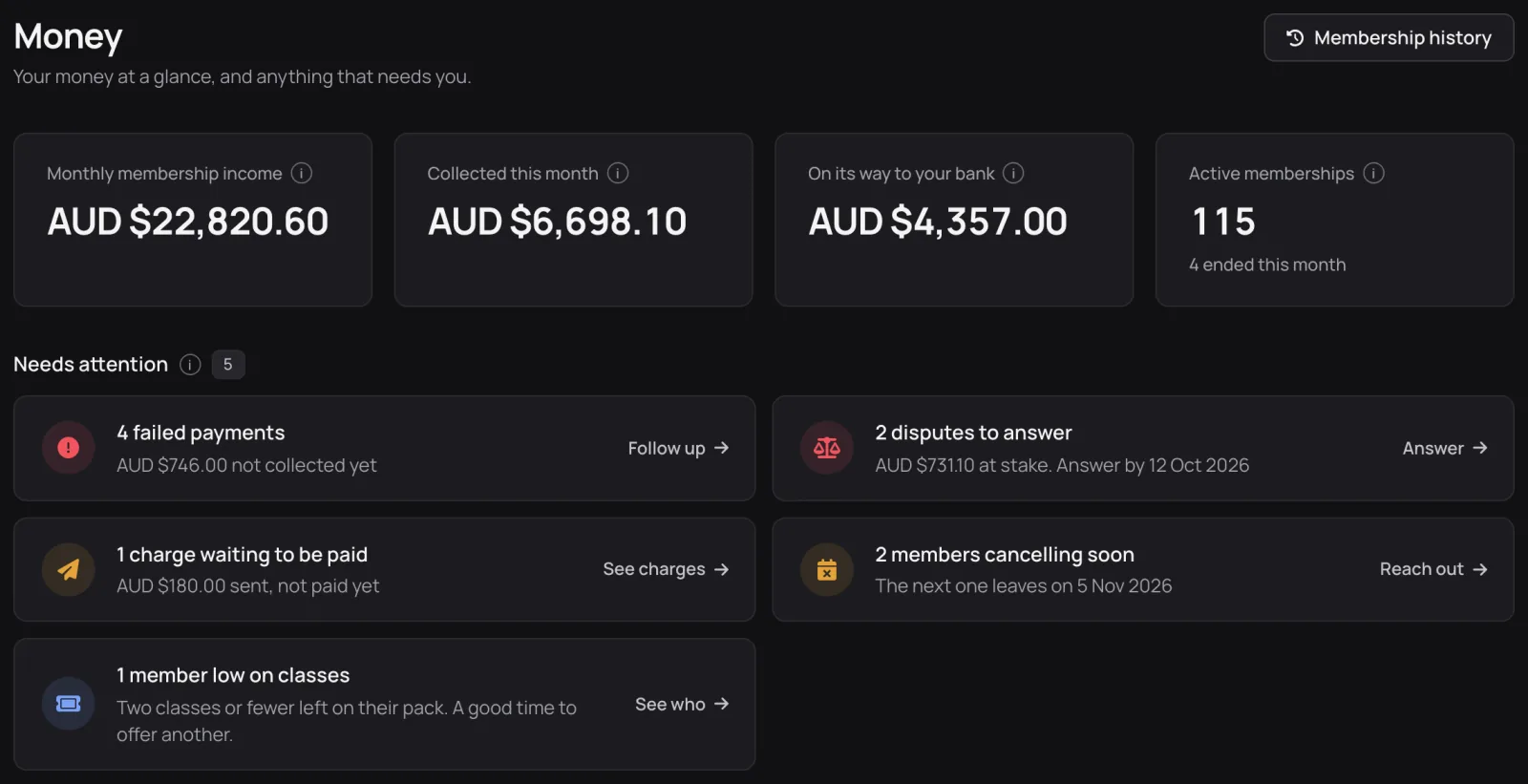
- Money shows monthly membership income, cash collected this month (card payments that reached your account since the 1st, less refunds) and the money on its way to your bank as separate figures.
- Failed payments under Money's follow-up list shows the memberships currently failing, the monthly amount at risk, how many newly failed in the last seven days and the reminders sent.
- At-Risk Members ranks active members by a score built from days since their last check-in, failed payments, cancellation requests, lost training streaks and how new they are. The dashboard shows the top five.
- Attendance reports total check-ins, busiest day and hour, a day and hour heatmap, and how many members train once, twice or three times a week over the last eight weeks.
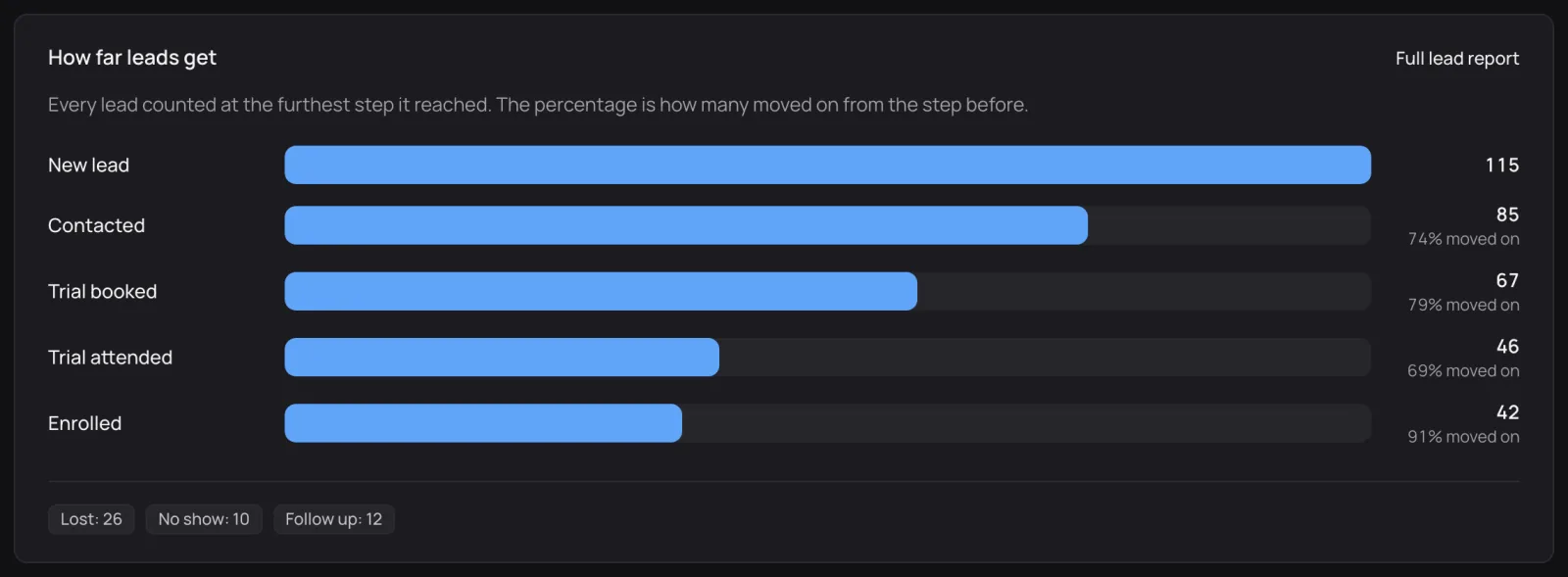
- Trial Conversion on the dashboard covers leads from the last 90 days: of the leads that reached an outcome, the share that became members. Leads still waiting on a trial are not counted yet. The Leads page shows the funnel step by step.
- Cancelling soon lists members who have asked to cancel and are still paying, with their reasons and a breakdown of why members left over the last 90 days.
- The weekly gym summary email arrives on Monday mornings with four counts for the last seven days: new leads, new students, total check-ins and promotions awarded. Use it as the prompt to open the dashboard.
See the analytics dashboard for the full list of reports. If you want to try the weekly review against your own academy's numbers, the free trial lets you connect it and see.
Frequently Asked Questions
What metrics should a BJJ gym owner track weekly?
Active memberships and how they changed, recurring revenue as a change since last week, newly failed payments, check-ins over the last seven days against the trend, a list of members going quiet, uncontacted leads and members who have asked to cancel. Slower numbers like churn and cohort retention are better reviewed monthly.
What is the difference between MRR and revenue?
MRR is what your active memberships would bill in a normal month, with weekly and fortnightly plans converted to a monthly amount. Revenue or cash collected is the money that actually arrived, which also includes one-off sales and is reduced by failed payments, pauses and refunds. Payouts are what reaches your bank after fees, on a delay.
How do I calculate trial conversion for a BJJ gym?
Divide the number of trial leads who became members by the number of leads in your chosen starting group: everyone who enquired, everyone who booked or everyone who attended. Each gives a different percentage, so pick one definition and keep it. Use a rolling 90 days, because weekly numbers are too small to be reliable.
How do I calculate churn rate for a gym?
Take the memberships that ended during a month and divide by the memberships active at the start of that month. Read it after the month is over, not partway through, because early in a month it will look artificially low.
Should I compare my gym's numbers with industry benchmarks?
Carefully, if at all. Reliable published benchmarks for small BJJ academies are scarce, and definitions differ from source to source. Your own trend over the last two or three months is a more useful comparison than an average from a different kind of gym.
How long should a weekly gym metrics review take?
About twenty minutes if the numbers are in one place. The time that matters is what comes after: the calls to members going quiet, the follow-up on new failed payments and the uncontacted leads.
Run your academy with Combat Control.
Trials, direct debit, check-in and belts in one place, built only for BJJ. We help you move across from your current system.