Your BJJ academy's Christmas shutdown checklist
A week-by-week Christmas shutdown plan for BJJ academies in Australia: holiday timetable, billing over the break, trial enquiries and reopening in January.
Most academies close for some part of the Christmas break. That part is easy. The trouble comes from everything around the closure that nobody wrote down: the member who turns up to a locked door on the 23rd, the direct debit that comes out in the middle of the break with no explanation, the trial enquiry that sits unanswered for three weeks, the "haven't seen you in a while" email that goes to your whole roster on New Year's Eve.
None of these are hard problems. They are all timing problems, and they are all solved by deciding a few things early and telling people clearly.
The Australian BJJ year guide covers why December empties out and how to plan the season around it. This guide is the operational version: what to decide, what to send and when, and a checklist you can reuse every year.
Decide three things before November is out
Every other step depends on these, so settle them first.
1. Your dates. The last class before the break, any reduced weeks, and the first class back. Write down actual dates, not "early January".
In 2026 Christmas Day falls on a Friday and Boxing Day on a Saturday, so many states add Monday 28 December as an extra public holiday. New Year's Day is Friday 1 January 2027. Arrangements differ by state (South Australia has its own December holidays, for example), so check Fair Work's 2026 public holiday list for yours. If you run any classes on public holidays and your coaches are employees, their award's public holiday rates apply. The casual instructors guide covers which award is likely to fit.
2. What members pay over the break. This is the question you will be asked most, and it is the one you can least afford to make up on the spot. More on it below.
3. Who answers enquiries while you are closed. Someone has to check messages and the trial inbox at least every couple of days. Name the person and the days now, before everyone scatters.
The timeline
Work backwards from your last class. If you close on Wednesday 23 December, it looks like this.
| When | What to do |
|---|---|
| Early to mid November | Set your dates, check your membership terms and settle the billing answer. Allow for any written notice your direct debit agreement requires. |
| Late November | Announce the dates to members, in person on the mats and in writing. Ask who is travelling and when they plan to be back. |
| Early December | Publish the holiday timetable. Process any pause or travel requests under your existing policy. Plan the first week back. |
| Week before closing | Send a reminder with the last class, the first class back and who to contact. Review which automated messages will fire over the break. |
| During the break | Check the trial inbox and member messages on the days you agreed. Reply to every enquiry with a first class date in January. |
| Week before reopening | Send the "we're back" message with the first week's timetable. Ring the trial leads who enquired over the break. |
| Two to three weeks after reopening | Check who hasn't come back yet and contact them personally. |
Two notices are better than one. People skim the first announcement, then forget it by the time they pack the car. A short reminder the week before you close catches them.
The holiday timetable
Two approaches work, and the one to avoid is running your full timetable through quiet weeks.
Close completely for a set period, usually from just before Christmas to the first or second week of January. It is simple to explain and it gives coaches a real break.
Run a reduced timetable through the quieter weeks: an open mat or two, maybe one fundamentals class. It suits academies with a strong core of members who don't travel, and it keeps the habit alive for them.
Either way, publish it as a plain list with dates, not as a weekly grid people have to work out. "Last class: Wednesday 23 December, 6pm. Open mat: Tuesday 29 December and Saturday 2 January, 10am. Full timetable from Monday 4 January." Nobody can misread that.
Take down or update anything that shows your normal week, wherever members and prospects might look: your website, your Google Business Profile hours, social media bios and the sign on the door. A prospect who drives over because Google said you were open is not going to try again in January.
Billing over the break: your agreement decides
This is the section to get right, and the first rule is that the answer depends on what your members signed up to, not on what feels fair in December.
Read your membership terms before you announce anything. Look for anything they say about annual closures, public holidays, pauses and how much notice you give for changes. Then sort the decision into two piles.
What your terms already settle. If your terms say the membership price covers a set number of training weeks across the year, or that billing continues through a published annual closure, then that is the arrangement. Say so plainly in your announcement and link to the clause. If they say members can pause for a set period with notice, apply that pause policy the same way for everyone.
What is up to you. Anything the terms don't cover is a business decision, and the common options are:
- Billing continues as normal, with the closure explained as part of the year's price.
- Billing pauses for the closed weeks and resumes on a set date.
- A credit or extension, so the closed weeks are made up at the end of the membership or on a later bill.
There is no single right answer, and this guide won't tell you which to pick. What matters is that the arrangement is consistent with your terms, that every member is treated the same way, and that you announce it before the break rather than after the bank statement arrives.
Two cautions while you decide.
Don't change the deal on one side. Changing what members get mid-contract without a basis in your terms is exactly the kind of one-sided move that unfair contract terms law is aimed at. Only a court or tribunal can decide whether a term is unfair, but the ACCC's guidance on consumer contracts gives a sense of what draws attention: one party able to change price or service while the other can't respond or leave. If your terms are silent on closures and you want them to cover it next year, fix the terms and get advice. Don't improvise this December.
Mind the direct debit notice. If your closure arrangement changes the amount or timing of members' debits, your Direct Debit Request service agreement sets how much written notice you have to give. Many Australian agreements say 14 days. Stripe's standard BECS service agreement says at least 30 days for changes to the terms of the arrangement. Check the one your members actually signed, and work back from your first changed debit date. That is why billing belongs in the November column of the timeline.
Travel pauses aren't injury freezes. Members heading overseas for a month will ask to pause. Handle those requests under whatever pause policy you already have, with a fixed return date. Injury freezes have their own rules about evidence, duration and holding fees, covered in the injury freeze policy guide. Keep the two separate so the holiday rush doesn't rewrite your injury policy by accident.
Trial enquiries don't stop when you do
People still look for a jiu-jitsu gym in late December, and some of them are the most motivated prospects of the year: they have time off and a New Year's goal forming. An enquiry that waits three weeks for a reply is lost.
Keep the door open, even with the lights off:
- Say you're closed, and say when you're back. Put it on your website and your enquiry auto-reply: "We're closed from 24 December. First classes back are Monday 4 January, and we'd love to see you at one."
- Reply within a day or two. That is what your named person and agreed check-in days are for.
- Offer a specific first class. "Monday 4 January, 6pm fundamentals" turns a vague maybe into a booking.
- Keep a list. Everyone who enquires over the break gets a personal call or text the week before you reopen.
If you run a reduced timetable, a trial can join an open mat, but think about whether a quiet holiday open mat is the best first impression. Often the first proper fundamentals class in January is the better invitation.
Check your automated messages before you leave
This is the step most academies miss. Automated messages are built for a normal week, and the break is not a normal week.
Before you close, go through every automated message and ask: will this fire while we're closed, and will it make sense?
- Absence messages. Most "we haven't seen you" messages trigger after a set number of days without a check-in. A three-week closure will trip that threshold for almost everyone at once, and your whole roster gets a "we miss you" message from a gym that is shut. Switch it off before the break.
- Class and trial reminders. Make sure nothing reminds anyone about a class that isn't running.
- Monthly reports and digests. A training summary for December will show very few sessions. That's fine if members expect it, odd if they don't.
Put the date to switch absence messages back on in your calendar. Don't switch them back on the day you reopen, or they'll fire for everyone who hasn't trained since before Christmas, including people booked in for later that week. About a week after reopening is better: by then the message only reaches people who haven't come back, and that group is exactly who it's for.
The broader rules for what to automate and when to pick up the phone are in the automations guide.
Reopening in January
The first fortnight back decides how many members you lose to the break. Three things help.
Send the "we're back" message the week before. First classes, the first week's timetable, and something that makes the first class back feel easy: a light first week, a fundamentals focus, an open mat with a barbecue after.
Ring the holiday trial leads. Everyone on your list from the break gets a personal call or text before the first class, with a specific session to come to.
Contact the people who don't come back. By the third week of January, check who hasn't trained since before Christmas. Some are still away. Some have lost the habit and feel awkward about walking back in, and a personal message from their coach is what brings them back. The seasonality guide explains why February is the month most academies sleep through, so start before then.
In Combat Control
If you run your academy on Combat Control, this is how each step works today.
- Holiday timetable. Delete individual classes in the weeks you're closed, and add recurring classes with a start and end date for a reduced holiday run. There is no single "closed from" switch, so each class in the closed weeks is removed one by one. The public timetable page shows your weekly pattern rather than dates, so put the closure dates in your announcement.
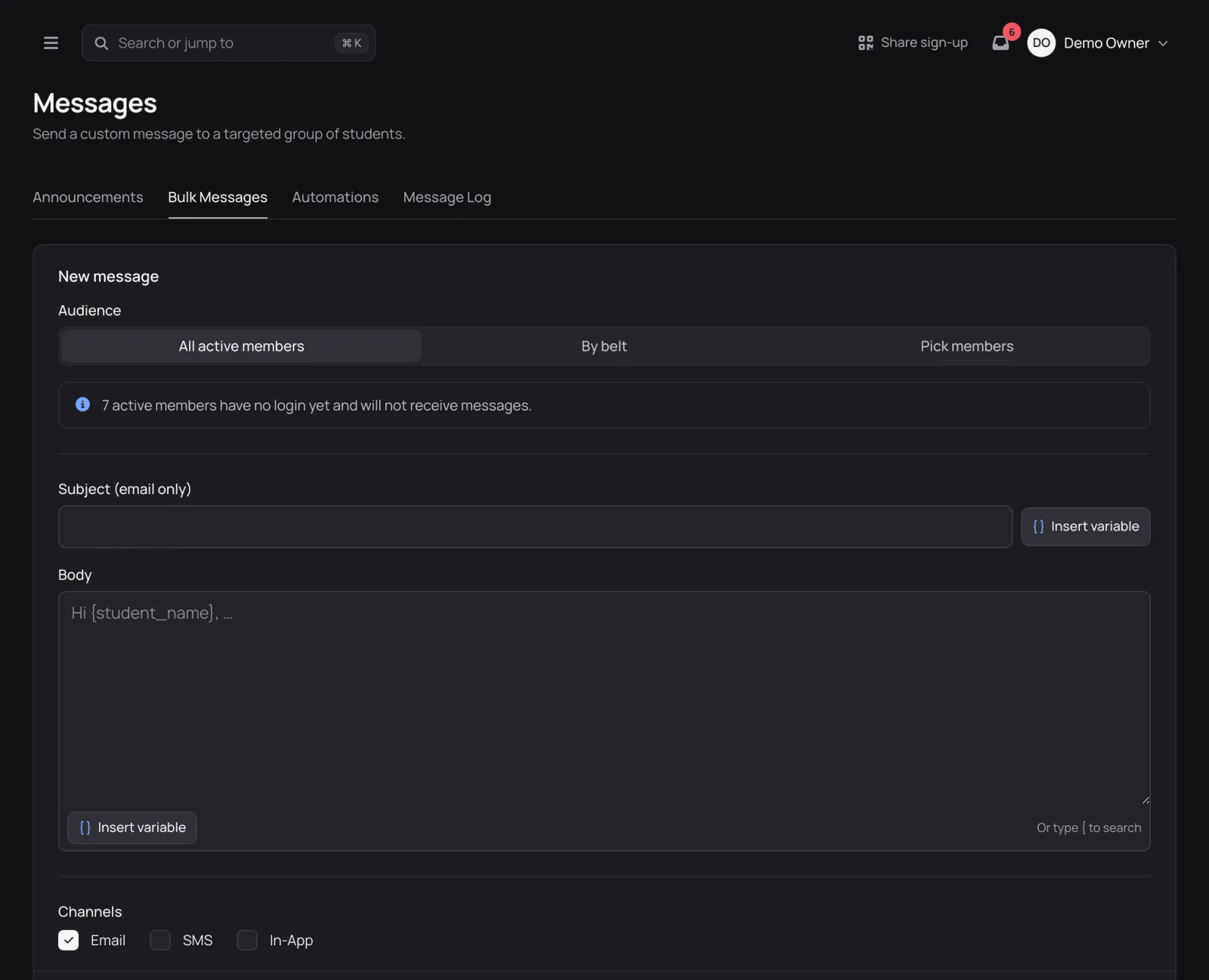
- Telling members. Deleting a class only notifies members who had booked it, and class booking is off unless you turn it on. So announce the break with a message.
- Messages sends an email, SMS or in-app message to all active members, a belt group, or members you pick. It sends straight away, so send each notice on the day you want it to land.
- Announcements posts to the News page in the member app, which is a good home for the holiday timetable members can check later. It doesn't send an email by itself.
- Pausing a membership. You can pause a member's billing from Money with an optional resume date. Stripe resumes billing on that date automatically. Pauses are set one membership at a time, and members aren't reminded before billing resumes, so mention the resume date when you agree to the pause.
- Trial enquiries. The booking form on your website shows trial classes for the next 14 days. When there are none, it shows "No trial classes available right now. Contact us directly to book." and still takes the person's details. You get the new lead email either way, so leads keep arriving over the break.
- Absence messages. The "haven't seen you" automation sends after 14 days without a check-in. It skips members who are paused or on an injury freeze, but it doesn't know about a closure. Switch it off on the Automations screen before the break and back on about a week after reopening.
See communications and automations for the full detail.
The owner checklist
Copy this into your notes and reuse it each year.
By mid November
- Last class, reduced weeks and first class back decided, with dates
- Public holiday dates checked for your state
- Membership terms read for closures, pauses and notice periods
- Billing arrangement decided and consistent with the terms
- Direct debit notice period checked and first notice date in the calendar
- Person and days named for checking enquiries over the break
Late November to early December
- Dates announced on the mats and in writing
- Members asked about travel plans and return dates
- Holiday timetable published as a dated list
- Website, Google Business Profile, social bios and door sign updated
- Travel pause requests handled under the existing policy, each with a return date
Week before closing
- Reminder sent with last class, first class back and who to contact
- Automated messages reviewed; absence messages switched off
- Enquiry auto-reply updated with closure and reopening dates
- Calendar reminder set to switch absence messages back on
During the break
- Enquiries answered on the agreed days, each with a January class offered
- Holiday enquiries added to a call list
Reopening
- "We're back" message sent the week before
- Holiday trial leads called or texted
- Absence messages switched back on about a week in
- Members not back by the third week of January contacted personally
Member announcement template
Adapt the details, keep it short, and send it in late November with a reminder the week before you close.
Subject: Our Christmas break dates
Hi {first name},
Here are our dates for the break.
Last class: Wednesday 23 December, 6pm
Open mat: Tuesday 29 December and Saturday 2 January, 10am
Full timetable back: Monday 4 January
Your membership: [one or two plain sentences on what happens to billing over the break, matching your membership terms].
Heading away for longer? Reply before 11 December and we'll sort out your options under our pause policy.
We're checking messages on Mondays and Thursdays over the break, so reply here if you need anything.
Thanks for a great year on the mats. See you in January.
The billing line is the one members read most closely. Write it last, check it against your terms, and leave out anything you can't stand behind.
A restrained word on software
None of this needs special software. A calendar, a spreadsheet and a group email will do it. Where software helps is making sure the notices go to every member, the trial enquiries land somewhere, and the automated messages don't embarrass you over the break. If you want to see how that works in practice, the free trial lets you set it up for your own academy.
Frequently Asked Questions
Do I have to stop charging members while my BJJ academy is closed for Christmas?
It depends on your membership terms. If they say the price covers a published annual closure or a set number of training weeks, billing can continue as agreed. If they are silent, decide on an arrangement, apply it to everyone and announce it before the break. Get advice before changing terms mid-contract.
How much notice do I need to give before changing direct debits?
Check your Direct Debit Request service agreement. Many Australian agreements require 14 days' written notice of changes, and Stripe's standard BECS agreement says at least 30 days. Work back from the first changed debit date, which usually means deciding in November.
When should I announce my Christmas closure dates?
Late November, with a reminder the week before you close. Announcing early gives members time to plan around your dates and gives you time to meet any direct debit notice period. A second, shorter notice catches the people who skimmed the first one.
Should a BJJ gym close completely over Christmas?
Either a full closure or a reduced timetable works. A full closure is simpler to explain and gives coaches a break. A reduced timetable of one or two open mats suits academies with members who stay in town. Avoid running the full timetable to near-empty classes.
What should I do about trial enquiries during the Christmas break?
Keep answering them. Say you're closed and when you're back, reply within a day or two, and offer a specific first class in January. Keep a list of everyone who enquires and contact them personally the week before you reopen.
Will my automated messages cause problems over the break?
They can. Absence messages trigger after a set number of days without a check-in, so a closure longer than that can send "we miss you" messages to every member at once. Switch them off before the break and back on about a week after you reopen.
Run your academy with Combat Control.
Trials, direct debit, check-in and belts in one place, built only for BJJ. We help you move across from your current system.